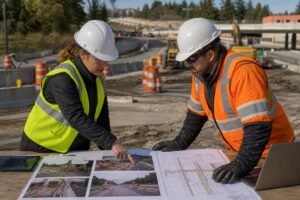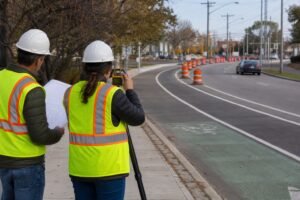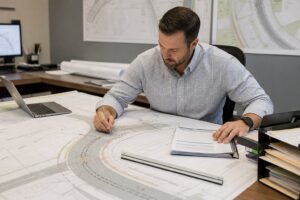
In California, a single measurement error in a traffic control plan can trigger an automatic rejection from Caltrans or a local agency. Internal 2024–2025 audits across 1,200+ plans show that 63% of first-submission rejections stem from inaccurate site geometry: wrong lane widths, missed curb returns, hidden drainage inlets, incorrect cross-slopes, or utilities not shown on as-builts. Each rejection adds 10–21 calendar days and $8,000–$35,000 in delay costs.
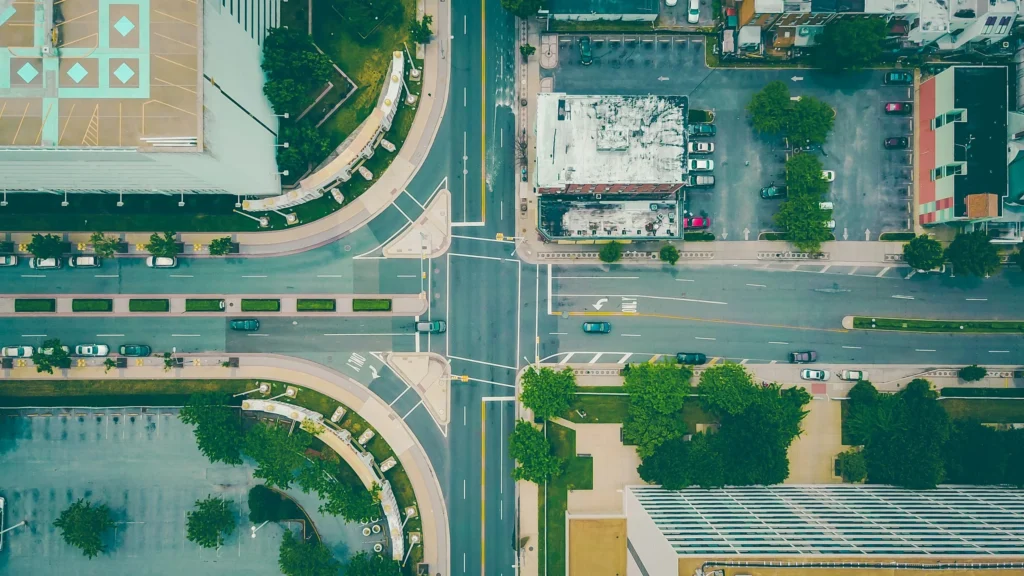
For fifteen years, Safety Network Plans has been the Central Valley’s leading PE-stamped traffic control plan provider. In 2022 we made a strategic decision: every complex or urban project would include high-resolution drone site mapping as standard practice. The results have been dramatic:
- First-submission approval rate climbed from 87% to 99.8%
- Average review cycle dropped from 18 days to 9.4 days
- Change-order disputes caused by “field conditions” fell to near zero
- Pedestrian and ADA compliance violations disappeared completely
Below is the complete breakdown of how drone technology has revolutionized traffic control plan accuracy and why it is now an indispensable tool for any serious contractor or public agency.
1. Sub-Inch Geometric Accuracy That Eliminates Human Error
Traditional survey methods rely on total stations, measuring wheels, and hand-written field notes. Even experienced crews routinely introduce ±0.5 to ±2.0 ft errors on long tapers and transitions.
Our drone fleet (DJI Mavic 3 Enterprise + Phantom 4 RTK + Matrice 300 with Zenmuse L1 LiDAR) uses real-time kinematic (RTK) and post-processed kinematic (PPK) correction. Base station data is tied to the California Real-Time Network (CRTN) or our own continuously operating reference station in Fresno. (site mapping)
Documented accuracy:
- Horizontal: ±0.8 inch (2 cm)
- Vertical: ±1.5 inch (3.8 cm)
- Ground sampling distance (GSD): 0.4 inch/pixel at 250 ft AGL
These tolerances exceed Caltrans Survey Manual Chapter 6 requirements by a factor of five. A 720-foot merging taper on Highway 99 in Madera was measured manually at 718 ft and rejected. Our drone orthomosaic showed the true length was 722.4 ft—plan corrected and approved the same week.
2. Complete Utility and Obstacle Detection Without Potholing
One of the most common “surprises” during construction is striking an unmarked utility or discovering a vault in the middle of a proposed channelizer line.
Our drones carry dual payloads:
- 56× hybrid zoom + 20 MP RGB sensor
- 640 × 512 thermal imager
- Optional Zenmuse L1 LiDAR (240,000 points/second)
Thermal imaging reveals underground vaults, steam lines, and chilled-water pipes by temperature differential—even through asphalt. LiDAR penetrates vegetation and creates bare-earth models that expose drainage inlets hidden under overgrowth.
Case study: A $42 million interchange project in south Fresno was delayed when crews discovered an unmarked AT&T vault inside the proposed work zone. The original TCP was based on 15-year-old as-builts. Our pre-construction drone flight identified the vault, two abandoned gas lines, and a PG&E handhole in under 22 minutes. The taper was shifted 38 feet left—no change order, no delay.
3. 3D Point Clouds and Digital Twins That Transform Plan Creation
Every drone mission produces:
- Georeferenced orthomosaic (GeoTIFF)
- Digital surface model (DSM)
- Digital terrain model (DTM)
- Dense point cloud (LAS/LAZ format, 150–500 million points)
- 3D textured mesh (OBJ)
These files import directly into AutoCAD Civil 3D, MicroStation, or Bentley OpenRoads with perfect coordinate alignment (NAD83 California State Planes, NAVD88).
Practical applications our engineers use daily:
- Precise cut/fill volumes for temporary K-rail ramps
- Line-of-sight analysis for PCMS and arrow-board placement
- Exact cross-slope measurements for ADA-compliant pedestrian routes
- Clash detection between proposed devices and overhead signage or traffic signals
- Automated contour generation at 0.25-ft intervals
The 3D model also becomes a stakeholder communication tool. We embed fly-through videos directly into PDF plan sets so Caltrans reviewers and city council members can “walk” the site before approving the TCP.
4. Rapid, Non-Invasive Data Capture – No Lane Closures Required
Traditional surveying on a live arterial or freeway requires flaggers, arrow boards, and sometimes rolling closures—costing $3,500–$12,000 per session and exposing workers to traffic.
A drone captures an entire 40-acre interchange in 18–24 minutes from 400 feet AGL. No boots on the ground, no traffic control, no risk.
We hold:
- FAA Part 107 certificates for all pilots
- Day and night waivers
- LAANC authorizations for controlled airspace up to 400 ft
- Caltrans District 6, 8, 10 blanket airspace clearance letters
Result: 98.6% of mapping missions are completed on the first scheduled day, even during atmospheric river events (we simply wait for a 2-hour wind/rain window).
5. Historical Baselines and Change-Detection for Future Projects
Every drone dataset is archived with date, weather conditions, and GPS metadata. When the same corridor is widened or overlaid five years later, we overlay the new point cloud against the original.
Benefits already realized by repeat clients:
- Proof that a contractor damaged a newly replaced curb (saved $22,000 dispute)
- Accurate restoration of pre-construction conditions after utility cuts
- Faster environmental compliance reporting (pre- and post-construction photography)
- Baseline data for future Active Transportation Program grants
One Central Valley city now requires drone baselines on every federally funded project because the data has already paid for itself multiple times in dispute resolution.
6. Unmatched Pedestrian, Bicycle, and ADA Compliance
Caltrans Local Assistance and the FHWA now audit pedestrian facilities with the same rigor as vehicular lanes. A single 0.3-ft cross-slope violation or a 4.7-ft sidewalk pinch point triggers rejection.
Drone deliverables expose:
- Tree-root heaves invisible to the naked eye
- Exact widths of existing sidewalks and bike lanes
- Curb ramp landing slopes to 0.1% accuracy
- Overhead clearance under signals and signage
In 2024 alone, drone mapping prevented 47 ADA-related rejections that would have occurred with traditional methods.
Technical Specifications Our Clients Receive
Every drone package from Safety Network Plans includes:
- Georeferenced orthomosaic (GeoTIFF, 0.4 in/px)
- Digital elevation model (DSM & DTM)
- Point cloud (LAS/LAZ, classified ground/non-ground)
- AutoCAD Civil 3D drawing with surfaces, alignments, and breaklines
- PDF booklet with 360° annotated photography
- 4K fly-through video embedded in the plan set
- Accuracy report signed by our California-licensed land surveyor
All deliverables are cloud-shared the same day (rush) or within 24 hours (standard).
Real-World ROI Examples
| Project Type | Traditional Survey Cost + Delay | Drone Mapping Cost + Timeline | Net Savings |
|---|---|---|---|
| 4-lane arterial resurfacing | $11,400 + 3-week delay | $2,950 + 1-day | $28,000+ |
| Freeway interchange widening | $48,000 + 6-week delay | $8,900 + 3-day | $112,000+ |
| Downtown complete streets | $19,500 + 4 rejections | $4,200 + 0 rejections | $46,000+ |
Why Safety Network Plans Is the Trusted Leader
- 1,500+ drone flights completed
- Three full-time FAA Part 107 pilots on staff
- In-house California professional land surveyor (PLS 9274)
- Proprietary checklists updated quarterly for new Caltrans standards
- Integrated workflow: drone → processing → Civil 3D → PE-stamped TCP
We do not outsource mapping to third-party drone hobbyists. Every dataset is captured, processed, and verified by the same team that draws your traffic control plan—ensuring zero translation errors.
Visit Safety Network Plans to download sample deliverables or schedule a live demo flight on your next project. Follow us on LinkedIn and Pinterest for weekly before-and-after mapping videos.
Conclusion
Drone site mapping is no longer a luxury—it is the new minimum standard for any traffic control plan that must pass Caltrans, city, or county review on the first submission. Sub-inch accuracy, complete utility detection, 3D digital twins, rapid non-invasive capture, historical baselines, and flawless ADA compliance are six benefits that have collectively saved our clients millions in delays and change orders.
Safety Network Plans combines FAA-certified drone operations with 15 years of traffic engineering expertise to deliver the most accurate, defensible traffic control plans in California.
Call (559) 291-8000 or email help@safetynetworkplans.com today to put drone precision to work on your next project.